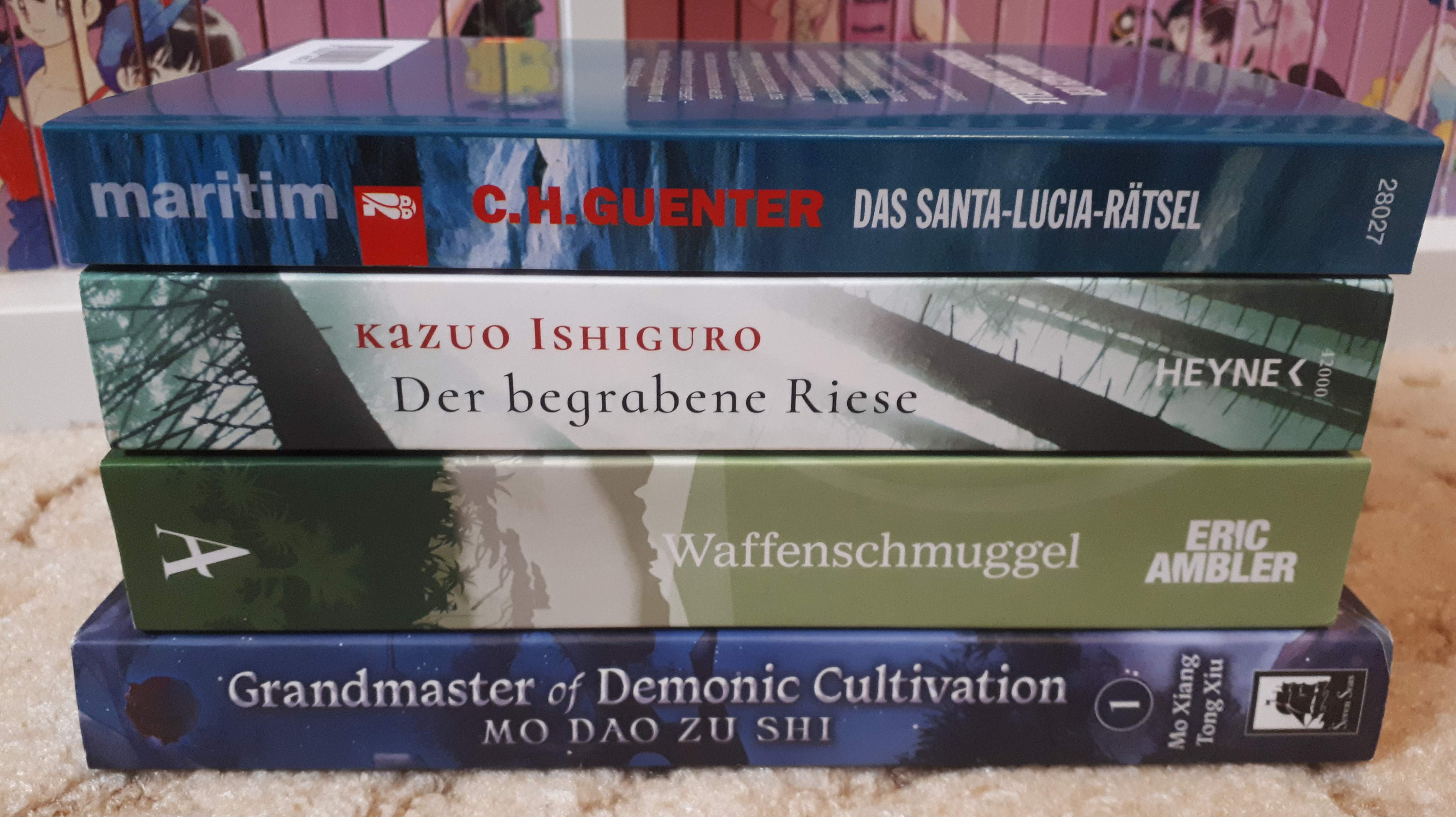
Looking at the books I read this month, I think 2022 will be a great year. There wasn't a single bad book this month, and there even were quite a few ones I really loved! Really nice...but on the other hand, things could only get worse from here on, haha.
The Sacred Book of the Werewolf (Victor
Pelevin)
I mostly picked this up because I was
going through the Guardian's 1000 books list and the title sounded
sort of intriguing. Also, I haven't read that many books by Russian
authors yet, so...I bought it, decided to take a short peek into
it...and finished it a few days later because it was just so good.
I'm not sure what kind of book I expected, but anyway, it defied my
expectations. I don't know if that makes any sense, haha. Well,
but...first off, I liked the main character A Hu-Li's way of telling
us her story, I liked the (pop)cultural references and I also really
enjoyed the often lenghty philosophical discussions between the
characters. I'm not sure if I really understood everything our
werefox storyteller tried to explain to her lover Alexander and thus
also to us readers, but nevertheless, it was extremely intriguing!
Also, I really couldn't predict where this would be going, but the
end was really satisfactory, if a bit sad. Anyway, I really recommend
this. I'm not sure if it's a book everyone should read, because I've
got a slight problem with saying things like that, but I'll say that
much: it's definitely a book worth reading.
Bei Anbruch der Nacht (Kazuo Ishiguro)
Looking back I definitely should have
picked another book to start this month's Ishiguro reading spree
because it's probably not his best work. On the other hand, it still
motivated me to start reading one of his novels right afterwards, so
it wasn't actually that bad. Eh, but whatever. This book is a
collection of short stories, each one of them being centered around a
musician or having some other connection to the theme of music in
general. I admit that I didn't really like the stories in the
beginning – the first one was alright, but there were some parts in
the translation which struck me as odd (yeah, well, I know I'm not
the one to complain, looking at how much my English sucks...and yet
I'm writing an english blog, oh the irony) and the second story was
outright stupid. Wanting to slap all three protagonists throughout
the entire story isn't very enjoyable, thank you very much. Well, but
it got a lot better after that. My favourite was the title story (I
think the original title of both was Nocturnes, which fits a lot
better than the german one because of the double meaning), though all
but the second one had their strong moments. Not something I will
necessarily read again anytime soon, but still better than expected.
Damals in Nagasaki (Kazuo Ishiguro)
Onwards to his first novel...was what I
thought after finishing the short stories. And whoa, this was really
good, especially since this was his first novel! I have to admit that
I knew beforehand that the narrator of the story, Etsuko, wouldn't be
a 100% reliable narrator. But I'm sure I would've noticed it at some
point. I absolutely don't understand how people could take her
narration at face value! First off, the story is set right after WWII
in Nagasaki, and I don't think we could expect the memories of a most
likely traumatised woman to be entirely accurate. Especially not if
she recalls those memories many years later. Second, there were some
scenes where the narration was clearly odd – like when Mariko, the
daughter of her friend Sachiko, kept mentioning a piece of string
Etsuko had on her person and that reference seemed to make no sense
at all! There were multiple scenes like that, but what really gave it
away was one scene near the end, where Etsuko suddenly mentioned that
'we could come back' instead of 'you could come back', supposedly
referring to Mariko and her mother. Granted, it was just a small
fleeting moment, a small error...but at that very moment everything
fell into place and made so much more sense. Other details about some
characters like Etsuko's husband Jiro aren't mentioned again, so I'm
not entirely sure about them, but...at this point there couldn't
really be any doubt about who Sachiko and especially Mariko really
were. Phew. I really loved this one and I just have to re-read it at
some point.
Der Maler der fließenden Welt (Kazuo
Ishiguro)
I went on to his next novel right away
(maybe I should just keep on reading them in order of publishing,
even though there isn't a connection between any of them), and I
enjoyed this one just as much as the previous one. The unreliable
narrator seems to be a recurring theme in the author's works, and at
least this one isn't an exception. Saying the most important things
through omissions is a common theme of Japanese literature (and
possibly even a defining Japanese characteristic in general), and so
this fits the theme and setting of the novel very well. I feel like
the narrator does actually want to come to terms with his problematic
past – he worked for the government during the war, e.g. creating
propagandistic art to support the war effort – but he also can't
quite let go of the old times. His struggle was obvious throughout
the book. And yes, I think the things he didn't say were the ones
that told the most. I also liked how some scenes mirrored each other,
like the recurring theme of the narrator noticing a burning smell at
especially crucial points of the story – and mostly the thing about
his father and later his arts sensei trying to take away his most
prized paintings. There is just one thing I never quite understood,
and that's the question whether the narrator really believed in the
politics of wartime Japan or if he just went along with everything.
Seeing how quickly he was ready to let go of some points I would be
inclined to believe he wasn't really into it after all. But maybe
that's just what he wanted us readers to believe. However, I don't
think not knowing a final answer doesn't take anything away from the
experience of reading this book.
Was vom Tage übrigblieb (Kazuo
Ishiguro)
(Just a little warning right at the
beginning, this will be pretty incoherent because I'm still not even
sure what I think about this book. Which is – I guess – a good
sign in itself?)
Uh, well. I sort of expected it,
but...this is probably Ishiguro's most famous and critically
acclaimed book, and yet... Yet I could bring myself to like or enjoy
it as much as the former two books. Let's start with the good things
though: the setting was a nice change of scenery, and the writing
style evoked a vivid picture of Britain in the 50s before my inner
eye just as well as the other books did for post-war Japan. I also
didn't mind the slow way of storytelling, and the fact that nothing
much happened but I still wanted to read on and on. However, there
was one big problem...which would be the main character. I just
couldn't bring myself to like Stevens. He's just not someone I would
like to know, and at times it was also pretty difficult to
acknowledge his view on some things. Maybe that's the point, though –
I have to admit that it was pretty intriguing to listen to this guy's
story and clearly seeing all those things he never even considered to
be true. Ultimately, he deceived himself thoughout his entire life,
staying away from anything he considered unneccessary for his job as
a butler. My main problem was his ignorance of his master's
antisemitic beliefs and collaboration with the Nazis. He just
pretended not to care – I wonder if that was just what he told
himself, because a few chapters earlier he went on about how a butler
can only be truly considered a great butler if he chooses a truly
great master to serve. Well, and if by chance he picked the wrong
master, then he basically had to pretend not to care, or else he
would have to admit that he too failed to become truly great.
Only near the very end of the book he
suddenly felt human to me. And that was when he was talking to
another guy, suddenly realising that he gave everything to others
(well, he did give up the years of his life to serve an ultimately
probably unworthy master, and he also missed the opportunity to get
the woman he loved, so that's about right) so that nothing is left to
him in the end. Honestly, I think that other guy never existed
though and the other man was just a part of himself, because I just
can't see him admitting failure to anyone else. I might be wrong,
though. (I'm also pretty sure that the passage about 'the rest of
life being empty', which was supposedly from Miss Kenton's letter was
in fact a figment of Stevens' inner thoughts. She didn't seem to
recognise that passage at all, so I'd say this was rather his
subconscious talking there.)
As a final thought, I don't think this
book could be considered a love story at all. (The german publisher
marketed it as such, I don't know if it was the same for English
editions.) To me it felt like a pretty sad story of an ultimately
failed life without much meaning, and the story of a man desperately
trying to fill that void while with his own convictions without
realising that life pretty much passed him by. So, not exactly a
pleasant read, but I think I know why it is considered a good book
after all.
The Day That Never Comes (Caimh
McDonnell)
I wasn't too sure whether I'd like this
as much as the first book. But in the end, it was of course just as
awesome. I liked the fact how both threads of the story – the
disappearance of Bunny and the gruesome murder cases plus the
connected public uprising – were connected in the end. And it was
also pretty evil how we were almost lead to believe that Bunny was
indeed connected to the killings in some way. Well, so the thrilling
part was great already, but that's not all there is to this book
series. There's also lots of funny stuff and the very lovable weirdo
characters. Seriously, during this book I got to love Phil even more
and that's why I also really enjoyed the ending. Guess I'm off to the
next book right away. Maybe I should take a break and read the
prequel first, though. Quite the hard decision, but I'm sure I'll
enjoy both books anyway.
Loch Down Abbey (Beth Cowan-Erskine)
What an odd yet endearing book. I
expected it to be a classical crime novel with lots of rich people
becoming suspects in a murder case while being confined to their
villa for whatever reason. Well, and confined they were, due to a
mysterious illness spreading around like wildfire. Hmm, I think I
heard of something similar in real life not too long ago... But
anyway, even though there was a murder it wasn't an actual crime
novel. It was more of a cross between a character study of rich and
very, very idle people...and a comedy story a la PG Wodehouse. Some
scenes were downright funny and even though most of the protagonists
were actually right pricks it was a great experience to read about
their misadventures. They had to learn to live without their servants
because almost all of them fell ill after a while – can you even
imagine that? The absolutele horror! My favourite scene was the one
where all the family member had to look for hidden doors in the whole
manor because the children were missing and giggling could be heard
from behind the walls. I also tremendously enjoyed some of the
revelations near the end. And, well, the very end came as a surprise
too. I liked the part after the final chapter where we learned about
the further lives of our protagonists. I assume that most of them
might be happier than they were during their time as rich idlers, I
guess. Anyway, a nice read, even though it wasn't quite what it said
on the package. That's not the book's fault, though.
Wanderungen durch Thüringen (Ludwig
Bechstein)
I mostly read this right before bedtime because it was
so relaxing, haha. Oh, and because it's about the region where I was
born, so it was quite fun. Though I have to admit that I've never
even heard of some of the places they visited during their hike. But
the chapter about my hometown was pretty funny, mainly so because
they apparently couldn't visit most of its many attractions because
of the bad weather. Well, that's a way to cop out of having to write
stuff too, I guess. Definitely something I need to take note of for
my own writings, I'd say. ;)
Heaven Official's Blessing vol. 1 (Mo
Xiang Tong Xiu)
I don't know if I should put this
rather on my anime blog, but it is a novel and I'm counting it
towards my annual reading goals, so... Anyway, I watched the donghua
adaptation last year and enjoyed it quite a bit – just like it was
with the other works of the author. So it's not surprising that the
announcement of English-language releases of her novels made me
really happy – I'd always wanted to read the originals! Heaven
Official's Blessing aka Tian Guan Ci Fu was the first one I picked up
because I wanted to refresh my memory of that story first. And it was
totally worth it, because it's highly enjoyable read. If it weren't
for the nice visuals of the donghua, I would definitely prefer the
written version anyway. By the way, this volume covers the first
series of the donghua, so there wasn't actually any new content. But
like I said, it was about time to refresh my memory. I can never
quite remember the details of most shows I watched...