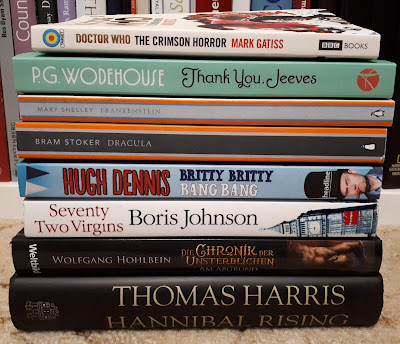
First monthly reads post on the new blog, yeah! I used to post those ones on my anime blog, but from now on I'll be putting them here. Anyway, October was a pretty good reading month - I tried to read some slightly spooky things in the run-up for Halloween and enjoyed most of them! (By the way, the books not shown on the photo are ebooks as I obviously couldn't take a picture of those.
Hannibal
Rising (Thomas Harris)
First
off, I haven't watched the classic Hannibal movies or read any book
of the original trilogy yet. However, I have at least watched the
Hannibal TV series, and that's why I started being interested in the
books, too. (Fun fact: I watched the TV series last October, but I
never mentioned it to anyone in real life...days later my mum
suddenly gave me this book and told me she bought it because it might
interest me. Quite scary, that. Even more so because my mum wouldn't
normally buy me a book about a serial killer even if I would politely
ask her to. Which made me seriouly wonder if she reads my blog.) So,
this is a prequel story about how Hannibal Lecter became the person
(and cannibal) we know. I actually liked reading this origin story. I
don't know whether someone who already read the other books would
think differently – actually, I do know from some reviews I saw:
they do – but from my point of view the story made sense. People
might say that giving Hannibal a sympathetic backstory takes
something away from the fascination of the character. Maybe they are
right, but I still wouldn't necessarily agree. Sure, if it were a
sappy story about how a entirely normal little boy turned into a
cruel killer because of some traumatic event from his past...no, that
really doesn't sound like Hannibal Lecter at all. But I got something
different from the story: how a boy with a brilliant mind descends
into darkness instead of stepping into the light and being recognised
as a genius on the field of medicine, for example. (I'm aware that
sounded a bit melodramatic. But that actually sort of fits the
subject, I think!) I did enjoy reading about that, and it made me
look forward to watching (or reading) the original trilogy one day.
Die
Chronik der Unsterblichen 1: Am Abgrund (Wolfgang Hohlbein)
I
usually enjoy Wolfgang Hohlbein's books. He's not one of my absolute
favourite author, but his stories are usually really thrilling and
just the right kind of book to read if I want to take my mind off
real life. And once again, I wasn't disappointed. This book is the
first volume in a long-running historical fantasy series, which is
the reason why it mostly served as a prologue for a longer story and
introduced a cast of characters we will probably meet again later on.
Also, I did recognise some tropes from the author's other books –
for example, the relationship between Andrej and Frederic reminded me
a lot of a similar dynamic between two characters from his book
'Thor'. Still, it was already plenty entertaining and I'm curious
about where the story will lead the main character and also us
readers.
Seventy
Two Virgins (Boris Johnson)
Oh
my. That was...bad. And to make two things entirely clear from the
beginning: no, I don't like Boris Johnson and no, I didn't expect
this to be any good – quite the contrary, actually. And yet I still
got disappointed. I thought there might still be some fun to be had
in reading this book, in a sort of 'ha-ha, I can't believe the guy
who wrote this shit got elected as PM of the United Kingdom' way. If
that makes any sense. What definitely didn't make any sense was the
book. I don't know, but the people who compared this to the writings
of P.G. Wodehouse might have been drunk, because...this book was
neither funny nor witty while the Wodehouse books are definitely both
funny and witty. And yes, I tried to forget who wrote this. It was
still bad. I have to add that I think I even got what he wanted to do
with the plot: lots of seperate plotlines which converge at a certain
highlight point of the entire thing, where everything gets resolved
and one of all those losers turns out to be a hero. Or something like
that. Just that it didn't work. I didn't care about those people at
all, and not even lenghty explanations about their past and
motivations could change this. Seriously, it was so obvious how he
tried to paint the British member of the terror gang as basically
just a poor guy who got mislead by the evil Arabs – while also
heaping on him because he was also some antisocial deadbeat who
basically just wasted taxpayers money through his sheer existence.
Add some more extra casual racism and sexism plus some semi-funny
puns on every second page and well, now that sounds the BJ we all
know and love. Or hate. Or love to hate. I really don't know anymore.
Nevertheless, I would still say reading this book was at least worth
something, because it made me feel better about my own writing. I
mean, seeing how even bad books can get published makes me feel less
anxious about whether the quality of my fanfictions is good enough.
At least I don't charge money for those, even if they aren't exactly
literature!
Britty
Britty Bang Bang (Hugh Dennis)
A
while ago I bought a few books written by British comedians,
partially because I just really like the author or also because some
nice people on Tumblr responded with lots of recommendations when I
asked them for Britcom-related books. This one here fits in the
former category because Hugh Dennis is one of my favourite panelists
from both Mock the Week and Taskmaster. And I was even pleasantly
surprised by the book, because I also learned some new things about
Britain while having fun reading an entertaining book. That's just
how I like it!
Carmilla (J. Sheridan Le Fanu)
I
initially downloaded this short novel because one reviewer called it
the superior vampire story when compared to Dracula. And I couldn't
really believe that, because...well, everyone knows Dracula, but
Carmilla? Not so much. (I knew her from the smartphone game
Fate/Grand Order. Yes, being a fan of anime and games does have some
benefits!) However, having read both stories I have to say....I
entirely agree with that reviewer! I just really enjoyed Carmilla,
and I can't believe that this story is actually even older than
Dracula because it felt so...fresh? Modern? I can't really put it in
words, I think. I mean, a story about a lesbian vampire preying on
young girls? That sounds like something straight from some of today's
B-movie horror flicks! However, there obviously isn't anything even
remotely similar to a sex scene in the novel (well, I'm aware that a
vampire's bite is basically a metaphor for a sexual act, but I think
you get my meaning) and so this isn't a cheap horror thrill, but a
really interesting and at times chilling and thrilling read. The only
thing I liked not as much was the ending because it felt somewhat
rushed and almost made me lose interest. But that didn't ruin my
overall enjoyment of the story and I would still absolutely recommend
it to anyone who would be interested in reading a classic vampire
story.
Dracula (Bram Stoker)
I
already mentioned Dracula, so...well, you already know that it's not
my favourite classic vampire novel. Don't get me wrong, there were
things I greatly enjoyed about it. The beginning of the story and the
first part set in Dracula's castle were just great and I was curious
to see what would happened next. Also, the parts about Renfield's
strange obsessions and also Lucy's story were intriguing. However,
everything felt just way too lenghty. Sometimes nothing meaningful
happened for many pages and especially the middle part after Lucys
death felt somehow dreadful – not because of Dracula's doing, mind
you. The ending part turned out to be more interesting, but I don't
think I'll ever feel the need to re-read this story, if I'm entirely
honest. And I think it is worth mentioning that I haven't watched any
film adaption of Dracula before reading the book. So I guess fans of
the various adaptions might not like the actual book at all. Still,
it was interesting to read about the origins of one of the most
famous literary and pop-cultural figures of all time.
Frankenstein (Mary Shelley)
Everyone
knows Frankenstein's Monster, and many people actually confuse the
creator (=Frankenstein) with his creation (=the Monster). Then again,
are they really wrong about thinking that this is a story about a
monster called Frankenstein? Because I for one absolutely came to
loathe the guy during the course of the book. I mean, creating a
initially gentle yet ugly 'monster' just to suddenly realise that he
possibly did a bad thing and thus leaving the monster entirely to its
own devices – only to revile his creation at their next meeting
which happened many months later. Still, the monster doesn't even
assault him like the proper ugly evil bastard it's supposed to be (if
he's ugly, then he has to be evil, right?) and tries to explain his
motivations and the way it lived to far. Well, at least then our
dashing hero sort of begrudgingly pretends to understand the
monster's plea and agrees to make a companion for him. (Not without
lots of whining though because he feels so bad about it! Seriously,
I've never seen a more whiny protagonist.) After another meeting with
the monster he suddenly decides to say 'fuck it, I'm not gonna do
this' instead and is subsequently really shocked that the monster
exacts his revenge against his creator. The rest of the book was
almost funny to me, to be honest. The wedding night scene almost made
me laugh: 'I fear that my wife might be in danger, so I'll just waltz
around our house and leave her entirely unprotected in our bedroom!',
just to be really surprised and shocked to find her dead when he came
back. I'm sorry, but that was funny. Then more whining ensued, before
he finally decided to man up a bit and chase his nemesis literally to
the ends of the world: the Arctic. That also where he tells his sob
story to the captain of a ship who rescued him – and the poor
captain basically seems to fall in love with his new acquantance,
judging from the way he talked about him. I just love how
Frankenstein repeatedly claimed that the monster possessed huge
powers of persuasion and no one should believe it when it talks about
its sad story. I think he mixed up things there: actually he was the
slimy smooth-talker himself, because he was so persuasive that he
basically calmed down a bunch of mutinous sailors in mere minutes.
The monster on the other hand never got a fair chance to persuade
anyone because of how ugly it was. So that's that, I'd say.
Anyway,
I guess this whole rant sounded a lot like I didn't like the book.
And that's not true, I actually liked it quite a bit. Maybe because I
sympathised with the monster in some way. Even though I'm obviously
not a artificially created giant person (I promise), I know how it
feels like to be judged based on wrong first impressions, always
being the odd one out and thus starting to feel a certain kind of
resentment towards other people. And I don't think I'm the only
person who can. Frankenstein, on the other hand...well, I rarely ever
hated a book protagonist as much as I hated him. Which is an
achievement in itself, I think! But the douchebag still didn't ruin
my enjoyment of the book, so...that definitely was a classic worth
reading, even though I fear that I lack the deeper understanding of
literature to properly analyse all the themes used in the novel.
Doctor
Who: The Crimson Horror (Mark Gatiss)
A
pretty enjoyable novelisation of a pretty enjoyable episode, I'd say.
Sure, the plot was pretty crazy and sometimes a bit over the top, but
I liked the Victorian setting a lot and the story had just the right
amount of craziness I enjoy about a Doctor Who story. The latest
stories in the TV series are sometimes a bit over the top for my
tastes, I have to say. But well, there's always the possibility of
rewatches or revisiting favourite stories via the novelisations!
Thank
you, Jeeves (P.G. Wodehouse)
I
read a collection of all Jeeves and Wooster short stories at the
beginning of this year, so it's quite odd that it still took me this
long to actually finish this first novel about their hilarious
adventures. Well, maybe because I'm determined to save up the
Wodehouse novels as a cure-all measure for bad reading slumps. The
short stories were basically the only thing I could still read when I
faced my worst ever reading slump, and I'll be eternally grateful for
that. I think I maybe liked the short stories a little bit more than
this full-length adventure, but it was still really, well...the bee's
knees would a fitting expression! It's not like I had any real
doubts, but I'll definitely go on reading the entire series now. And
I'll also want to take a look at PG Wodehouse's other books – good
thing that there are so many of them!
A
Case of Blackmail in Belgravia (Clara Benson)
I
only read this because I could download the ebook version for free,
but I actually enjoyed it a lot! I'm just really weak for stories set
tin 1920s/1930s England, whether it's a crime novel, a comedy story
or really anything. This one falls in the first category and while it
wasn't exactly one of Agatha Christie's books it was still highly
enjoyable. I might buy the next volumes in the series too, if I ever
feel the need for some light fun reading because that's exactly what
I got from this novel!